
This is the second of three essays written in conjunction with the installation of SaraNoa’s works at the Institute for the Study of Ancient Cultures in Chicago’s Hyde Park. The works explore the removal, storage, and decay of monuments through the stories of Hyde Park’s stone monuments. The exhibition runs through March 14, 2027.
Read the first installment here.
About 20 years ago, a villager in the Konya Plain of south-central Turkey discovered a stone monument on the slopes of a vast ancient mound. It told the story of Hartapu, a little-remembered Iron Age king, in bold Luwian hieroglyphs. The villager began searching for a buyer in the antiquities trade, hoping to change his fortunes for the better.
Instead, his life fell apart. He got into a tragic fight with a neighbor and was sent to prison for a decade. It was hard not to feel haunted. When he returned home, he got rid of Hartapu’s monument once and for all, dumping it in an irrigation canal. It lay submerged in the water for years.
In 2019, my PhD advisor, James Osborne was surveying the area around the ancient mound with his colleague Michele Massa when a local farmer led them to the discarded inscription.
An exhibition about the monument opened at the Institute for the Study of Ancient Cultures Museum in Chicago two weeks ago. But they left Hartapu’s monument in Turkey. The centerpiece was a painted, plastic 3D-scan—a replica of a stone that refused to leave.
~*~
Around 1180 BCE, the Kassite king Meli-Shipak II gave a plot of land to his son and designated successor, Marduk-apla-iddina. To commemorate the event, he carved a large diorite stele and set it up in the courtyard of the temple of the all-seeing sun-god Shamash at Sippar, 20 miles from modern Baghdad.
Two decades later, in 1158 BCE, Meli-Shipak’s son-in-law, Shutruk-Nahhhunte, raided the temple as the Kassite kingdom disintegrated. Along with the Naram-Sin Stele and the Code of Hammurabi, Shutruk-Nahhunte had the land-grant stele dragged to Susa. In doing so, he ignored the stele’s ominous warning:
If anyone removes this stone and places it elsewhere … May Marduk, the great lord, whose uttered word no god can evade, impose upon him the punishment for his great fault! May he wander on the public square of his city, seeing only anger, stretching out his hand and not being fed! ... May Gula, the lady, the sublime, the princess of all ladies, put oozing sores on his body, a persistent carbuncle with no release so that, as long as he lives, he may bathe in blood and pus like water!
—Sb 22, translated by Jean-Vincent Scheil in 1900 and Kathryn Slanski in 2003.
Shutruk-Nahhunte died three years later. His empire lasted only a generation longer.
~*~
Stone monuments rarely leave their homes willingly. Again and again, they stymie and humiliate the empires that try to take them away.
This has been true ever since royal monuments were first carved out of the living rock. The largest obelisk ever attempted by the ancient Egyptians cracked in the quarry at Aswan around 1500 BCE. It still lies there, abandoned by the workers in exasperation.
Two thousand years later, when the Roman emperor Constantine ordered an obelisk dragged from Karnak Temple in Egypt to his new capital at Constantinople, it snapped on the journey and was abandoned in Alexandria for a generation. The obelisk only crossed the sea after Constantine’s death. It was the last obelisk ever moved by the Romans.
When the French tried to raise the Luxor obelisk in Paris in 1836, they used it as an opportunity to exhibit the power of an early steam engine. But the boilers gave out and they had to lift it with 120 human bodies.
When the English tried to ship an obelisk from Alexandria in 1876, it was lost at sea during a hurricane. Six sailors died trying to reattach it to the tow boat. The next day, the massive monument was found by another ship, still floating in its metal tube. The captain finally towed it to England but refused to let it be taken ashore until he was paid a ransom of £2000, today $400,000.
~*~
But the stone monuments’ greatest act of resistance took place in 1855, aided by a group of local outlaws.
The French expedition had been digging at Khorsabad on and off for 12 years. The site, not far from Mosul, was the most grandiose and short-lived imperial capital in the Ancient Near East. It was built as a palace-city during the reign of Sargon II, the king of Assyria, in the 8th century BCE.
He is most famous for conquering the ancient kingdom of Israel. Perhaps the enslaved exiles helped drag Khorsabad’s reliefs and winged-bull Lamassus from the quarries. They were the largest installed in any Assyrian palace, towering over the supplicants, diplomats, and courtiers that visited.
Ten years later, Sargon was killed in battle, and the new capital was abandoned.
The French consul to Mosul and his army of local workers began tunneling through the corridors of Sargon’s palace in 1843. In the first years of the excavation, they sent a few bits and pieces to Paris, but they only started the large-scale operation to drag the Lamassus and reliefs away ten years later, in 1853.
For direction, they studied the reliefs just found at nearby Nineveh, the last capital of the Assyrian Empire. These reliefs, made under the direction of Sargon’s successor Sennacherib, illustrate the techniques originally used to transport the Lamassus from the quarries.
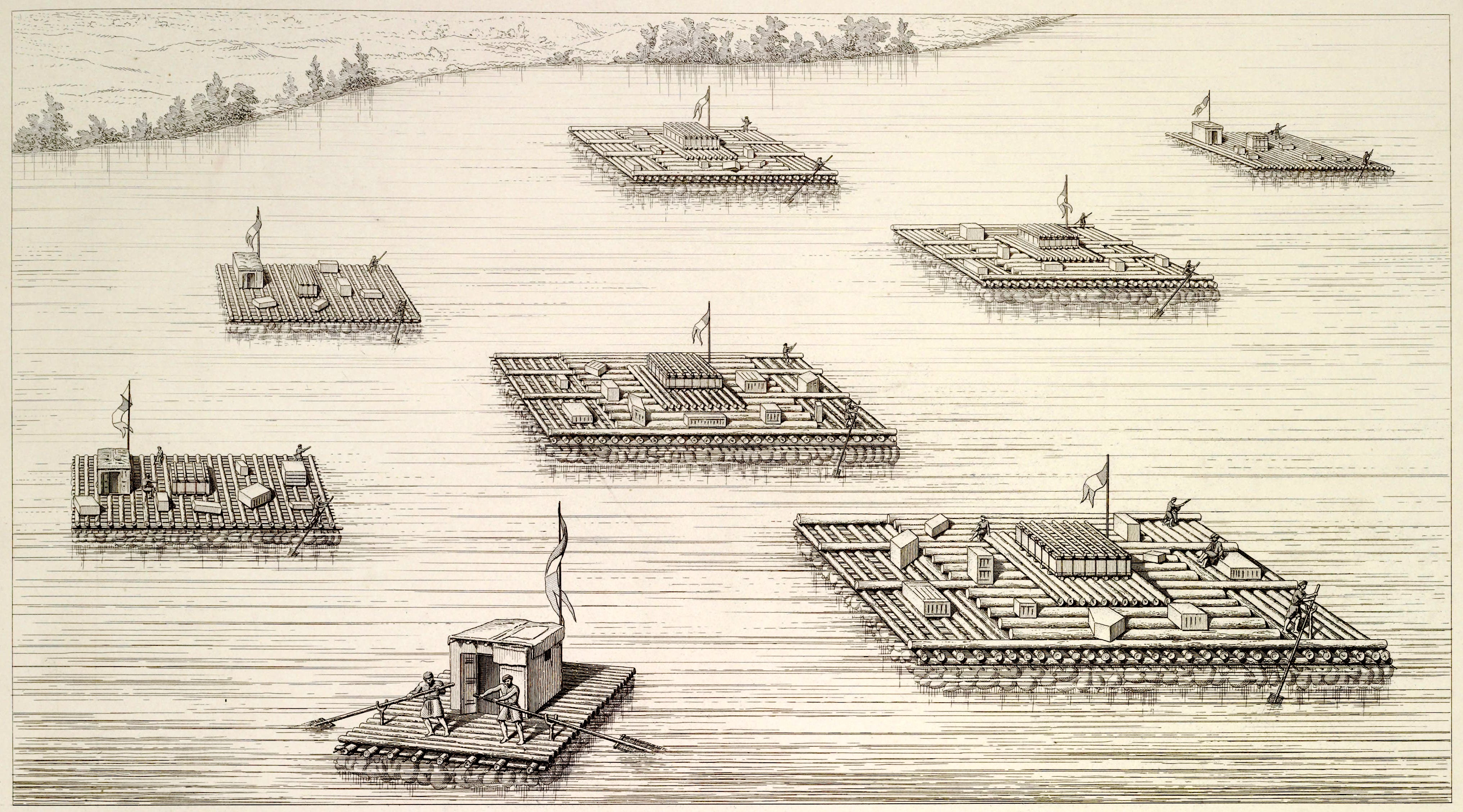
The French team constructed huge carts and wood rafts buoyed by inflated skins. Six hundred local workers dragged 235 crates of reliefs and Lamassus 12 miles to the Tigris.
Supervisors on horseback threatened the stragglers with long sticks and drummers laid down the marching beat — tactics learned from enslavers in the American South. The excavation director stood on top of the crates, shouting orders. Workers laid the sculptures on the rafts and began to float them downstream to Basra, where they were to be loaded onto sea vessels to sail around the Horn of Africa to France.
They never made it there.
There are conflicting accounts of what happened — everyone was trying to save face. What they agree on is that the rafts were attacked by pirates 50 miles from Basra and the monuments sank to the bottom of the river.
According to the French excavation director, the local Arabs couldn’t understand why Europeans would be interested in antiquities and thought they must be transporting something with greater market value.
A local Ottoman official had a different explanation. A French supervisor had loaded bales of silk onto the rafts at Baghdad to smuggle to Basra, since the rafts were exempt from river taxes. Word got out, and both the silk and the wood of the rafts were taken by the pirates to rectify this blatant corruption.
Either way, the pirates prevented most of the reliefs and sculptures from ever leaving Mesopotamia. The antiquities sank to the bottom of the river. Of the 235 crates, only 28 were ever recovered and shipped to the Louvre. The rest still lie at the bottom of the Tigris, while the stone monuments wear into river pebbles.
For most of the carved monuments of Sargon’s vast palace, the only records we have are the quick sketches that were made during excavation.
~*~
The ill-fated French excavations were over. But a team from the Oriental Institute at the University of Chicago returned to Khorsabad in 1928, during the final days of post-World-War-I British occupation before Iraq gained independence. Immediately, they wanted to take what remained of Sargon’s enormous reliefs and Lamassus back home with them to Hyde Park, Chicago. Most of the reliefs that the French team had left exposed had already cracked and fallen apart.
Nevertheless, 150 tons of fragments were being loaded into crates by 1929 and shipped down the Tigris and across the Atlantic.
Again, the monuments resisted. The steamboat carrying the iron and wood equipment needed to raise the sculptures out of the ground burned on the way from Baghdad. By the time they managed to start the work, the summer sun was so scorching that the iron tools were too hot to touch. Sand flies swarmed into the workers’ noses and eyes. The crates were so big that they broke the trailer bed of the 10-ton truck they were placed on and later overturned the entire truck. Eventually, the engine gave out and the truck had to be dragged to the riverside, as its wheels sank into the soft sediment. The steel cables used to drag the truck tore repeatedly.
When they finally loaded the crates onto the river boat, the vessel became too heavy, and it had to be pulled out of the river mud by hand.
Once in the United States, the crates needed to take a specially planned train route from New York to Chicago to avoid all tunnels because of their size. In the end, the money required to move the fragments far outstripped the other costs of the expedition. When the fragments were unpacked in Chicago, the Institute built a new museum around them — the one that still houses the Institute for the Study of Ancient Cultures today.
An enormous Khorsabad Lamassu is the centerpiece of the museum. It was reconstructed inside the exhibition hall, where it still stands a century later. It is supported by a brick and steel foundation under the floor. The doors are far too small for it ever to be removed with the museum intact.
It arrived in Chicago at around the same time as my great grandparents came to the same city from Turkey.
I joined the Lamassu in 2014 as a PhD student in the Institute, another 100-year exile from across the ocean. Between classes, I stood in front of the stone behemoth, in awe of its arresting presence.
SaraNoa took a job guarding the collections a couple years later. It was the museum’s centennial, and all the exhibitions were being removed one by one and re-installed for the occasion. There was a flurry of activity. Curators and preparators rushed in and out with carts and keys to open and empty the display cases. The objects were in transit once again.
In the meantime, SaraNoa paced the galleries, watching over the vacant cases, bare armatures, and the shadows of missing artifacts on linen-wrapped pedestals.
But amid all this traffic, one monument remained motionless: the Khorsabad Lamassu.
~*~
In two weeks: Life and Survival
Previous: Dragging the Monuments Away.
Start from the Beginning: Watching a City Drown.
Text © 2026 Akiva Sanders. Drawings © 2026 SaraNoa Mark. Photos © 2026 Akiva Sanders and SaraNoa Mark, unless otherwise indicated. All rights reserved.
All ideas shared here were developed jointly in conversation.
Further reading
Place, Ninive et l’Assyrie (French Imperial Press, 1867) – The original report of the French expedition to Khorsabad, including the official account of losing the reliefs and Lamassus.
Genç, “Memory of destroyed Khorsabad, Victor Place, and the story of a shipwreck” (Journal of the Royal Asiatic Society, 2021) – Translation of a local official’s version of the events.
Loud, Khorsabad, Part 1: Excavations in the Palace and at a City Gate (University of Chicago Press, 1936) – The original report of the Oriental Institute expedition to Khorsabad.
Neumann, “From Khorsabad to Chicago: Re(Telling) the Story of the Assyrian Reliefs at the Oriental Institute” in Dieux, rois et capitales dans le Proche-Orient ancient (Publications de l’Institut du Proche-Orient ancien du Collège de France, 2023) – Curator at the ISAC museum gathers records and telegrams relating to moving and installing the Khorsabad Lamassu in Chicago.
