
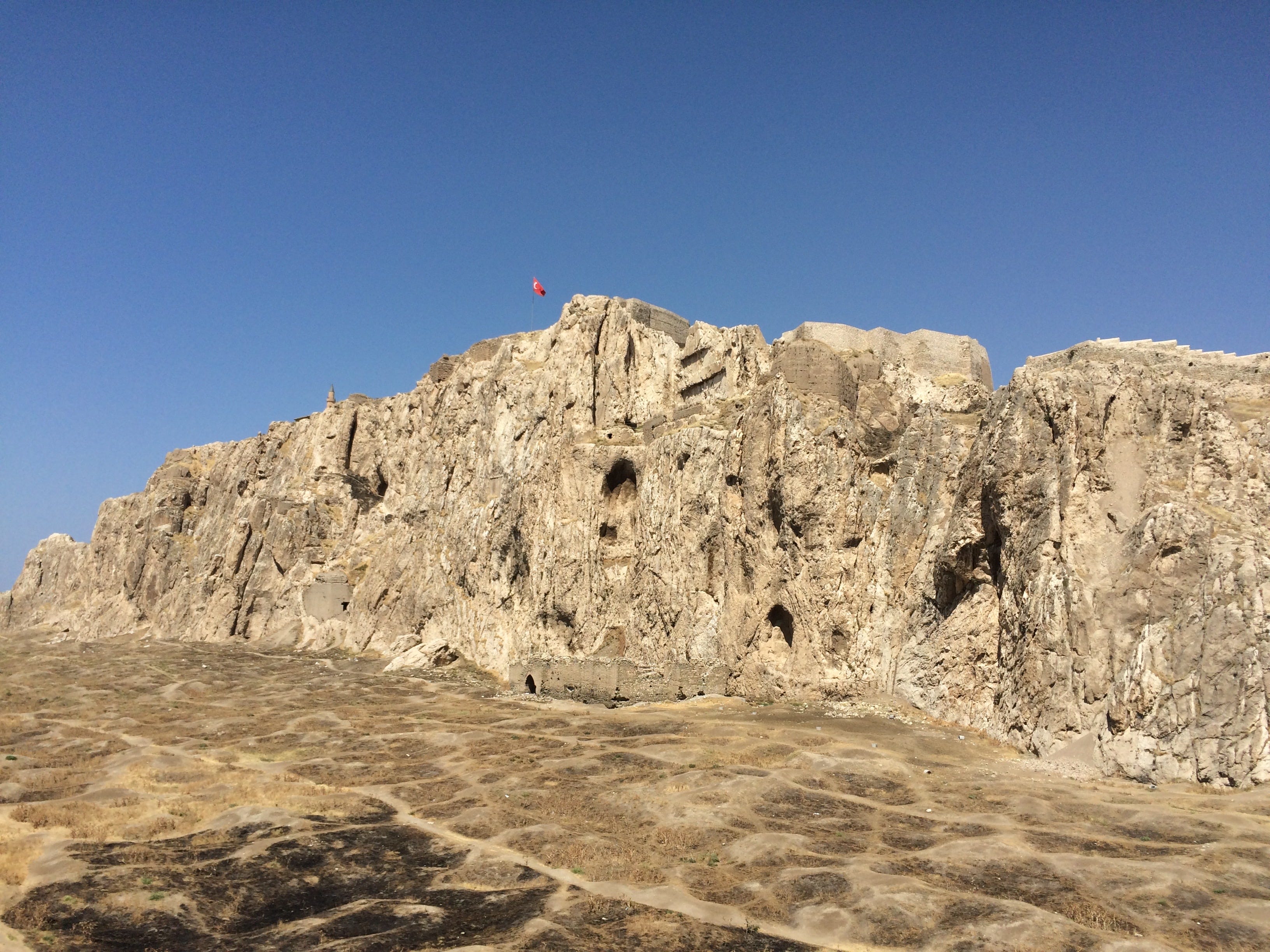
We climb into the tomb.
Panting, soaked with sweat from the steep ascent, our eyes need a moment to adjust. Gradually, the scene comes into focus. Fragments of stone cover the floor. The carved benches that once held 2,000-year-old skeletons have been smashed to bits. Someone is searching for something.
They won’t let the dead rest.
~*~
Most places that survived the 20th century are full of ghosts. My ancestors are among the many that inhabit Turkey.
My grandmother’s parents were from Kırkkilise. It’s a sleepy small town in Thrace, where Turkey, Bulgaria, and Greece meet. Today there’s a replica of the house Atatürk grew up in on the town square. The original is across the border in Thessaloniki, Greece, where my grandfather’s family was from.
It was a region wracked by the worst kinds of atrocities during the Balkan Wars of 1912–13, when the Ottoman Empire was collapsing and the borders of Greece, Bulgaria, and Turkey were first being drawn. Kırkkilise was controlled by all three countries between 1912 and 1923. Each change of hands was a catastrophe for residents who did not speak the language or profess the religion of the conquerors.
My family was Jewish, neither Greek nor Bulgarian nor Turkish.
The dust had settled by the 1930s. Turkey had changed the town’s name from Kırkkilise (40 churches) to Kırklareli (the place of forties). The Bulgarians were forcibly removed in 1913, the Greeks in 1923. Most of the Jews had left too — including my great-grandparents. They were replaced by a flood of Muslim refugees forced out of neighboring countries.
But the minorities that remained were still distressing to Turkish authorities who dreamed of building a nation united in language, history, and values.
On June 14, 1934, the Turkish parliament passed the “resettlement law,” mandating the destruction of non-Turkish Thracian communities through forced relocation and assimilation.
On July 3, riots broke out in Kırklareli to enforce the law. Jewish property was destroyed and bands roved the streets searching for women to rape.
While doing research on my ancestors I was relieved to discover that my great-grandmother had escaped the riots.
She had died in Istanbul on July 1.
~*~
My brother and I visited Kırklareli in 2022. On the street where our great-grandfather once owned a tavern, we asked one bartender after another how we might be able to see the town’s synagogue. Finally, one directed us to the gas station down the street owned by the synagogue’s caretaker.
The caretaker opened the doors of the synagogue. It was dark and dusty, but everything was organized and in good repair. Most of the scrolls and books had been taken to Istanbul, but the chairs, the lamps, the podium, and the ark stood as they always had, waiting to be filled again with light and chatter. The caretaker led us to a back room. Its walls were covered with yellowed photographs and newspaper cuttings.
“This was the old man whose children moved him to their apartment in Istanbul, but he kept sneaking back here every time he left to get milk or cigarettes.”
The newspapers read: “Last 18 Jews in Kırklareli.” “Last 12.” “Last 8.”
Now, only the caretaker and his mother remain.
~*~
There’s a way I feel whole during my long research stays in Turkey, reunited with those I lost before I was born — the ones whose names I know but whose voices I never heard. As if the stones of a city can absorb a voice’s echo. I certainly miss the feeling when I’m somewhere else.
But as someone living in a now-foreign place that was once home, I am often lonely when I’m there. So I rely on some of my time-tested strategies: Go on walks long enough that you are part of the blood pumping through the city’s arteries. Go to the synagogue to hear the old people laugh. Hang around in bars until someone talks to you.
The last strategy led me to “Mustafa,” a middle-aged bartender at a fish restaurant on the Bosphorus. I was sitting alone at the bar, sipping my way through one beer after another, watching the music videos flashing on the TV.
We connected over the music. He told me he was from Urfa, trying to get by in Istanbul to feed his family.
Urfa is known all over the Middle East as the birthplace of Turkey’s most popular and bombastic singers. In antiquity, it was the capital of a kingdom nestled between the Roman and Persian Empires. At its center lies a cave that was the birthplace of Abraham, according to local lore. Half the city was destroyed in 1915 when the local Armenian community violently resisted deportation.
Mustafa grew up as a shepherd, and his brother was still in the family business back in Urfa. I said I was interested in coming along some time.
Shepherding is an interest of mine — learning to spend a long day outside, to develop a private language with another species — and I join whenever I can. It also has the cachet of Abraham and Moses and King David. He said he would arrange it.
I mentioned I was an archaeologist, and our conversation changed immediately. He leaned in and started showing me pictures of strange rocks on his phone that his brother had found while following the sheep. Stones carved with crosses and snakes and one-word inscriptions. I was entranced.
In archaeology, the first step when trying to understand the history of an area is surface survey. A team of three or four drive around the landscape for about a month in a jeep with a GPS receiver, a camera, and a notebook, recording anything that strikes their educated fancy and politely cross-examining locals.
But shepherds conduct a surface survey every day for decades. They know every strange rock, every unnaturally shaped mound, every flint blade scatter. No one can claim to know a landscape better. So I was delighted to see the spoils of Mustafa’s brother’s many expeditions.
And then came the question I eventually learned to expect: “Does it mean that there’s gold?”
~*~
A fever for treasure hunting has swept across Turkey. You can find it everywhere once you know to look for it. Ancient rock-cut tombs and sanctuaries smashed with sledgehammers or dynamited to bits. Treasure-hunting videos on Instagram and Facebook. The incessant questions when someone hears you’re an archaeologist. And the text messages: An image of a rock carving and a request to confirm that it is, in fact, a clue from National Treasure.
Like stone-quarrying, treasure-hunting activities concentrate in the places that are most awe-inspiring to look at — the places that scream out to everyone who passes: “There is something special here!”
Something archaeologists and officials are hiding, threatening you not to tell.
At first, the absurdity was amusing. I told a senior archaeologist about what was happening and he became very stern. It’s a serious problem, he said, and if you correspond with any of these people you can be thrown in jail.
And then I learned why treasure hunters assume there is treasure to be found in the first place: There is a belief that Armenians, when they were forced to march into the desert in 1915, buried their prized possessions and left clues, hoping to find them when they returned.
They did not return.
~*~
In Central and Eastern Turkey, the exile of the Armenian population left a gaping hole. Empty villages and churches are hard to miss in the landscape.
But an openhearted, official recognition of what happened never came. In the century since, foreigners have used the Armenians’ dispossession as a justification for humiliating military occupation, executions, and assassinations aimed at the Turkish state. Each of these events felt like an existential threat, reopening the wounds of citizens who had themselves fled their homes in the Balkans or the Caucasus even as the Armenians were being driven out of Anatolia.
In response, the Turkish government has made broadcasting its narrative of “The Events of 1915” a top priority. Toeing the party line in public is a prerequisite of good citizenship.
The hole the Armenians left has festered.
Some know that they have Armenian ancestry and whisper it to whoever stops long enough to listen. Some have an inkling of what their grandparents did and shudder when they hear 1915 mentioned.
But all know that the place isn’t the same without them.
Most readers understand what it means to live in a place once inhabited by communities that were driven out by the very people who made it a home designated for us.
I certainly do.
We maintain a relationship with those driven-out people, even as it is warped and twisted by time and distance.
In public, we might explain what happened. We might mourn the tragedy that it had to be this way, strike our chests for the crimes of our ancestors. We might apportion some blame to the exiles. Say that they were too dangerous to stay, that our ways of life were simply incompatible. That they would have done the same to us if they had the chance. These comments may each have some basis in reality.
But they fail to address our deeper feelings. In truth, we romanticize them, we fetishize them. We yearn for them more than we care to admit.
We fear that they belong here more than we do. That they might have some right to claim what was taken from them: our comfort, our homes, our identities.
And we envy them because they still live in this place’s sepia-toned, enchanted past, while we are imprisoned in its sanitized, pessimistic present.
Today’s Turkey is filled with skyscrapers, video ads, and a desperate hunger for self-understanding. Perhaps the land’s history has the answers. Dreamers across the political spectrum hope to find them there.
But the ghosts of the Armenians have subsumed every remnant of antiquity. Treasure hunters search for their presence in every ruin and carving, no matter how old.
The ghosts have come to stand in not only for what is missing in the present, but for everything that is seductive, mysterious, and forbidden about the past.
It’s a treasure that will never be recovered.
~*~
Next: Dragging the Monuments Away.
Previous: Monuments and Quarries.
Start from the Beginning: Watching a City Drown
Text © 2026 Akiva Sanders. Drawings © 2026 SaraNoa Mark. Photos © 2026 Akiva Sanders and SaraNoa Mark, unless otherwise indicated. All rights reserved.
All ideas shared here were developed jointly in conversation.
Further Reading:
Haker, Once upon a Time Jews Lived in Kırklareli (Gorgias Press, 2010) — The book that guided me in the search for my Kırklareli family.
An article from Daily Sabah discussing the confrontations between treasure hunters and military police.
