
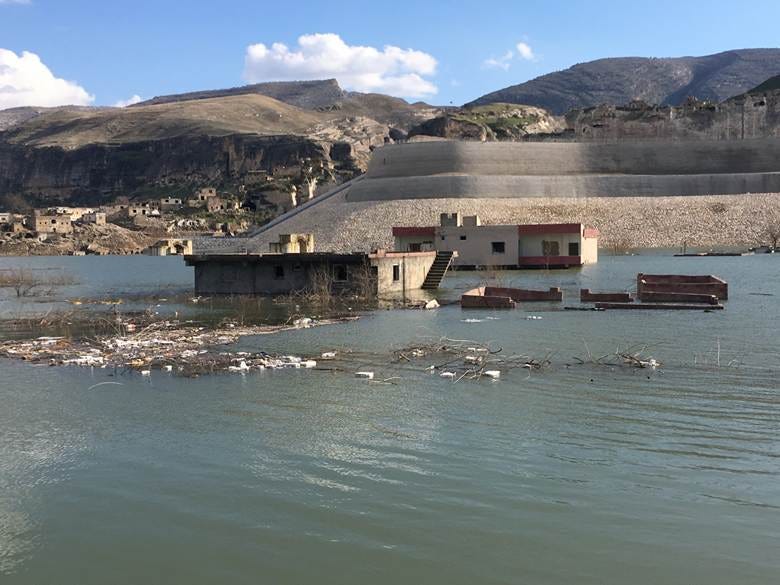
The water was swallowing the town of Hasankeyf after 12 millennia of continuous habitation. We watched it from the old cemetery, after all the bodies had been ripped out, one by one.
It was late February 2020. We were starting to see what was coming.
To prepare, I’d bought The Decameron — Boccaccio’s stories of a group of friends who fled Florence when plague shut down the city in 1348. I was reading it on the bus from Batman, the provincial capital, to Hasankeyf, while SaraNoa watched the landscape pass through the window.
In two weeks, the Fulbright commission would tell us to come back to the US or have our funding cut. In three weeks, we would spend the night in hard plastic chairs among the cries of pleading parents and apologizing gate attendants, hoping we didn’t miss the last flight out of Istanbul.
This was going to be our last expedition in Turkey.
We were going to watch Hasankeyf go under.
~*~
On the bus, terraced, golden-gray hills raced by. It was on these hills where people first experimented with planting wheat and barley 11,000 years ago. This was where they trusted that they could give up some of what they gathered this year so they could have more next year. Where they first built permanent houses next to their fields. Where they built tubs to store their harvest and sharpened spears to defend it. It’s the place they started watching the skies, looking for any sign that there would be enough rain to stay in the homes they had built.
This tied-down way of life allows us to build great cities and monuments—but it also makes our existence more inflexible, in many ways more precarious.
~*~
Finally, the gleaming water of the Tigris River came into view.
Of the two rivers that Mesopotamia depends on for sustenance, the Tigris is the moodier one. It falls more rapidly from the mountains to the sea and it’s harder to tame. Nevertheless, it has fed three of Mesopotamia’s greatest cities—Nineveh, Ctesiphon, and Baghdad—capitals of empires that matched its restlessness and violence.
Its source lies between the jagged cliffs of the Taurus Mountains, about 75 miles northwest of Hasankeyf. Out of a rough rock tunnel, the water swells, impatient to begin its wild journey to the sea. Three thousand years ago, two Assyrian kings made the arduous journey to the tunnel.
They carved their image into it.
Floods have been a concern and fascination of Mesopotamians since they began recording their thoughts on clay tablets. They relied on the twice-yearly flood to water their fields and save them from hunger.
When the water didn’t come, cities were abandoned. If the deluge rushed in too fast or too strong, the work of generations could be destroyed. It’s no coincidence that a “great flood” was the quintessential catastrophe in Mesopotamian literature.
The earliest sciences—reading goat entrails and shooting stars—were desperate measures to make some sense of this life-threatening uncertainty.
To live in this fertile heartland of cities, communities—and later temples, states, and empires—had to learn to control the waters of the Tigris. They dredged channels to direct the floods to the fields and piled up reed bundles and earth dams to keep the deluges out. When Mesopotamia’s kings first tried to make their names eternal by carving them into clay, they bragged about these tasks more than anything else.
This role never disappeared. The first modern hydroelectric dam in Mesopotamia was completed in 1959 on the Little Zab, a tributary of the Tigris that runs through the Assyrian heartland.
By 2020, the governments of Turkey and Iraq had built seven on the Tigris, turning it into a series of lakes. Every dam made the river a more predictable resource for agriculture and power generation. But for the villages and towns, ancient and modern, built along its banks, it became an angel of death—once and for all.
Mesopotamia is not unique in this. When the Glen Canyon Dam was completed in Northern Arizona in 1966, thousands of ancient sites were submerged or washed away. Glen Canyon Dam is one of about 2,500 hydroelectric dams in the U.S. Altogether, they generate about 6% of our electric power.
A modern dam is constructed to last 50–100 years.
~*~
So when work began on the Ilısu Dam in 2006, the residents of Hasankeyf knew that the end was near. They had years to fear the waters before they finally started to rise in 2018.
The Turkish government made its own preparations. They had to decide which fragments of the town were worth saving, and which ones would be left to drown. It’s the same thought process we go through when we create landmark districts, write historical plaques, and fill museum inventories. When we decide what not to include in our parents’ estate sale.
What do we need to hold onto? How do the fragments we preserve define our values and our histories—our collective identity? How can we strip these of the messy, living purposes they were made for and put them toward a new function as mementos, as touchstones, as nostalgia pieces? Who has the right to make these decisions?
The case came before the European Court of Human Rights. Activists argued that the Hasankeyf community has a right to transmit their heritage to their children by using places created by their ancestors—houses, grave markers, streets, markets—places that would be destroyed by the dam. They were talking about millennia of history built into the fabric of the town and the caves that surrounded it.
They used the same logic that city governments apply when they prevent a homeowner from replacing a window on a century-old building. The same principle that justified our horror when we saw the images of pit-filled ancient cities looted by ISIS.
The court decided this is not a universal human right and declined to hear the case.
~*~
The bus approached Hasankeyf, nestled into the canyon walls surrounding the Tigris. The first thing we saw was the new town just completed by the Turkish government. It was a suburban housing development, the kind you might expect to find on the outskirts of Dallas, built directly adjacent to the highway—a new, artificial artery, now that the old one was destroying everything that relied on it.
Behind the rows of cookie-cutter houses we found the new cemetery. The bodies from the old graveyard had been meticulously moved there one by one and provided with identical bright white tombstones.
Then we saw the archaeological park. A museum of the old town’s grandest edifices, ripped out of their urban fabric. There they stood, among immaculate concrete paths, each to be viewed alone as a painting in a frame. They had ceased to be mosques, burial shrines, and community centers, and they had become triumphant monuments to a collective national memory.
Something to give transcendent meaning to a new highway-and-subdivision way of life.
The monuments were placed high on a promontory directly above the canyon. From there, we could finally see the old town far below us, and the water now coming to the tops of the pylons of the medieval bridge that collapsed four centuries ago.
But the largest feature that confronted us was the enormous concrete ramp that had been poured to drag the town’s monuments to the archaeological park. It covered the rugged orange canyon face like a cheap tarp tossed onto a grand piano.
The construction workers had carted the mosaic-covered, domed, 15th-century tomb of Zeynel-Bey up this ramp in one piece. They took only fragments of the El-Rızk Mosque, including its minaret and carved portal, and replaced the rest with newly carved stone.
The bustling marketplace, used continuously since Roman times, was demolished to make way as they dragged the El-Rızk minaret through the heart of the town.
They covered the Mardinike complex, a medieval community center already in ruins, with sediment to preserve it, and they let it go under, never to be seen again.
Even before the water came, the city had been plundered.
As we descended the canyon slope, we came to the old cemetery. It was pockmarked with pits where the bodies had been unearthed. But the tombstones remained, witnesses to generations of care for the dead. Their styles and shapes recorded the radical transformations of the past few centuries, a microcosm of history.
Many had been shattered during the corpse extraction process.
Between the pits, much of the town had gathered with their families to eat picnics packed in shiny new kitchens. We watched the rising water snake up the winding streets and fill their old homes—lived in, falling apart, filled with memories.
Four women sat discussing the new appliances that the government installed in their new houses. A young man told us that he kept going back to his old house every day, though the security forces had blocked the bridge with a pile of debris and it would only be a few days until the water covered it.
We sat in the cemetery until the sky flooded with color and then faded into darkness. But it didn’t feel like a funeral.
~*~
We all lose most things eventually. Our memories dissolve and shift with time until they no longer resemble the lives we have lived. We do spring cleaning, we renovate, we move. Our parents die. Things that we counted on to tell us our stories slip away—photos, furniture, cassette tapes, school assignments. It happens gradually and we may not anticipate the loss until long after, when we try to use the slipped-away things to remind us of a past world we can no longer access.
So we mourn. We feel nostalgia in its original Greek meaning—the pain of homecoming. We return hoping to find comfort, and we discover that the things we left for later are no longer there.
The residents of Hasankeyf experienced this loss differently. They had over a decade to mourn. They had already emptied their houses and sold what they couldn’t carry and wouldn’t leave behind.
Now was the time for spectacle. Not just a goodbye, but a catharsis: The secrets of alleyways and crannies. Places where innocence was lost, friendships made and broken. Moments of tenderness and
anger, pride and regret. All swept away at once with the flood. Melting into an undifferentiated blue surface.
It had long been foretold—not by a goat’s liver or a street-corner prophet, a Noah or a Jeremiah, but by bureaucrats and builders armed with the measurements, schedules, and bulldozers to make it happen.
“This is the day we’ve waited for. We have found it. We have seen it.”
So instead of dirges and tears, circus-style tents popped up along the water. Residents figured out how to make a quick buck—they built a café on a barge made from discarded shipping pallets and plastic sheeting and dragged it every morning to the new shoreline to sell tea.
There was an almost-festive atmosphere, much like the surreal, bleak whimsy of the Decameron. And why shouldn’t there be?
When the world you know is being destroyed, what is there to do but watch?
~*~
Next: Picking through the remains.
Text © 2026 Akiva Sanders. Drawings © 2026 SaraNoa Mark. Photos © 2026 Akiva Sanders and SaraNoa Mark, unless otherwise indicated. All rights reserved.
All ideas shared here were developed jointly in conversation.
Further Reading:
ECHR’s 2019 Ahunbay and others v. Turkey judgment.
Handžić et al. “From Living Town to Open-Air Museum: The Displacement and Musealization of Hasankeyf’s Heritage.” (2026)—A record of what happened to 12 Hasankeyf monuments during the flood.
