
This is the third of three essays written in conjunction with the installation of SaraNoa’s works at the Institute for the Study of Ancient Cultures in Chicago’s Hyde Park. The works explore the removal, storage, and decay of monuments through the stories of Hyde Park’s stone monuments. The exhibition runs through March 14, 2027.
Read the first installment here.
I inherited my grandfather’s picnic spot, 80 years later.
It’s an artificial peninsula that juts out into Lake Michigan, in the neighborhood of Hyde Park, Chicago, flanked by five levels of monumental limestone blocks.
My grandfather arrived in Chicago in 1940. He slept under the table in his aunt’s small apartment on Greenwood Avenue, on the edge of the University of Chicago and a mile from the Point. Not every Balkan Jew in Chicago lived in Hyde Park, but the community chose Promontory Point for their monthly picnics in the summer because it was an incredible place to be.
It was almost new in those days. The city started to push construction debris and trash into the lake in 1924 to build the peninsula. They planted grass there in 1929, the same year the Khorsabad Lamassu arrived from Iraq in the under-construction Oriental Institute, on the University campus. The limestone blocks were added to the Point in 1937 by formerly down-on-their-luck WPA workers.
From then on, the Lamassu and the Point served as the neighborhood’s two defining stone monuments, but their lives could not have been more different. They represent all of Hyde Park’s deep contradictions: the buttoned-up University and the wild neighborhood, the life of the mind and the life of the body, the international and the rooted.
The Lamassu stands behind a rope, warning visitors not to touch. It’s climate controlled, protected from the elements, meant to last forever, frozen in time. Visitors can look in silence. They can admire it and ponder it. What it says about the long-lost empire that made it, about the human condition. But it will never be an important character in the moments when the visitors feel most free. That isn’t tolerated in a museum.
The Point is a different kind of monument. Its very foundations are the detritus of the city. Old bricks from workers’ cottages demolished to make way for lakeshore condominiums still come to the surface with the pounding of the waves in the rage of summer storms.
It’s different in every season. Stained with wine, cigar smoke, and sweat in summer. Covered with 30-foot ice cliffs in the depths of winter.
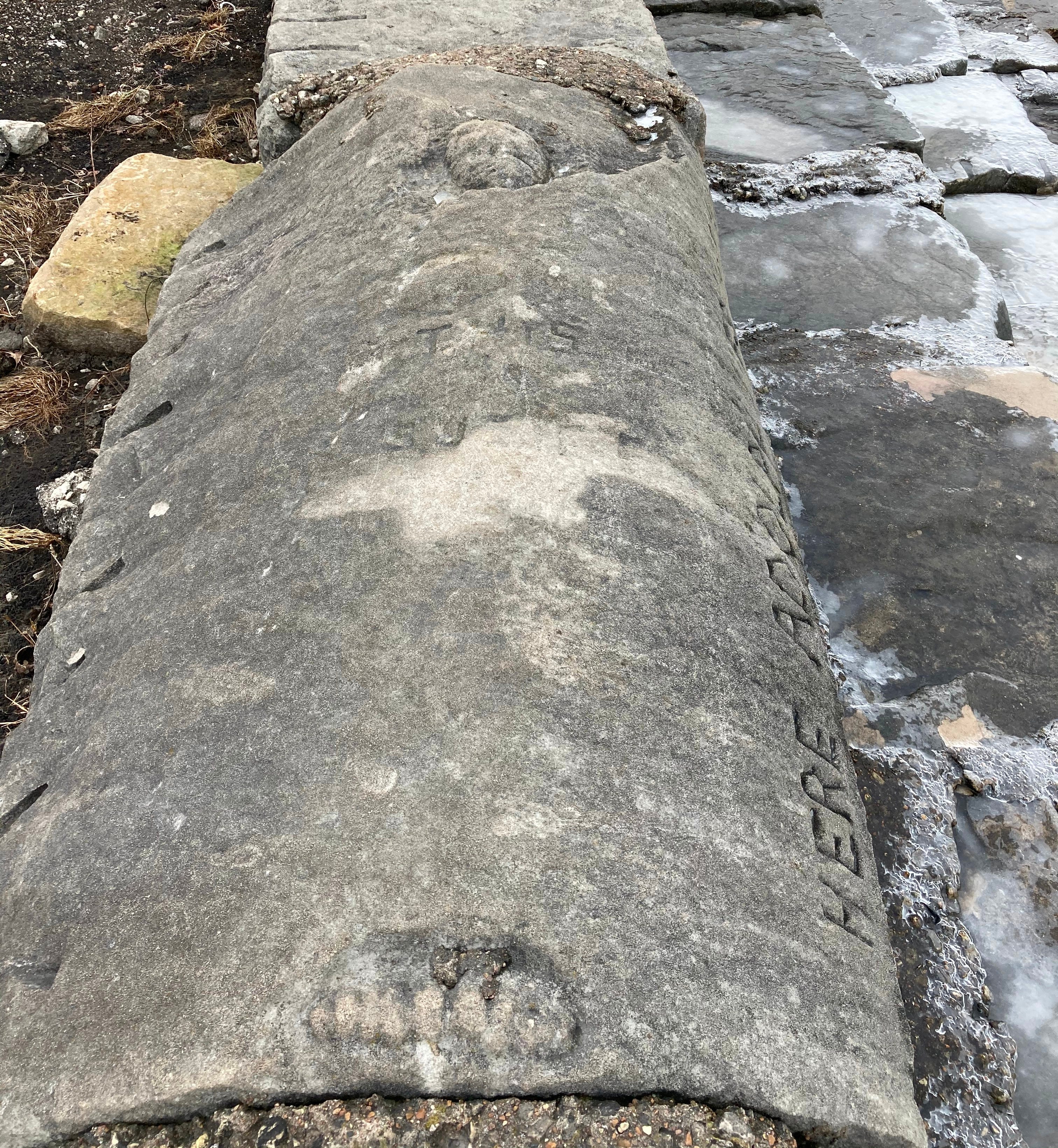
It’s never finished. Hundreds of carvings have appeared over the years -- expressing every kind of emotion felt by those who fell in love, discovered themselves, or mourned a lost friend on the always-welcoming stones. The Lake watched and responded, still and patient as glass or insistent with churning foam.
It’s a place of ritual. Every morning and every evening, communities of swimmers return to the place they met and became friends — peeling off their clothes and jumping into the water, sharing food and fire.
It’s an enchanted place where hours can pass, measured only by the movement of the sun and the growing feelings of trust for those there with you.
~*~
In the long days when the world stood still in 2020, there was nowhere like it.
The summer sun beat down on chattering picnickers. It was a place to be face-to-face in an impossibly constrained world. It, more than any other place, was the beating heart of the Hyde Park community. We would come every day, knowing that we’d find the same smiling faces — ones we gradually recognized as close friends.
The leaves changed color and snapped in the wind, one by one. The community couldn’t bear to say goodbye. So in the evenings, when the pleasant autumn air gave way to frigid night gales, groups of friends gathered bricks and chunks of stone worn by the waves and made their own bonfire circles.
At first there were one or two scattered on the limestone blocks. But by November, they crowded every flat space with a little shelter from the wind. It was understood that one should not arrive at the Point without fallen branches. An axe was stashed between the stones.
Every night at midnight, a patrol car would come by to clear out the park.
Those who wished to stay built their fires on the lower levels of stones, out of sight of the road.
Eventually the snow covered the fire circles. Long days at the Point contracted into hours or minutes, the most important in the day. Those who saw this time and the Lake’s water as a lifeline still shared fires on the snow and cut through the ice to dip. The frigid Chicago gales numbed our stinging bodies, forced us shoulder-to-shoulder around the flames, hands outstretched towards it as if in prayer.
But by March, the snow had retreated from the fire circles, and the Point filled with friends once again.
In the spring, our friend DD interviewed the most omnipresent members of the daily Point community. The interviews meandered through the experience of the daily return: the quieting of the incessant rhythm of time like a mute on a snare drum, the feeling of sun and water by turns bracing and relaxed like a heartbeat, the clearing of a mental fog that only the Point’s community could chase away. SaraNoa carved their words into chunks of asphalt, discarded bits of the city that had been worn smooth by the churn of the lake and thrown back by the waves.
~*~
Promontory Point is decaying into Lake Michigan. It is inevitable in such a place. The waves, the sun, and the wind fill it with a passion that cracks the habits and the anxiety that constrain our daily lives.
But year after year, they also crack the rocks themselves.
Beginning in the 1990s, the city of Chicago has been replacing the limestone blocks lining its lakeshore with concrete. Accessible. Unfriendly. Easy to repair in the future because no one would care enough to stand in the way.
For the city, it was one of many moments of optimistic self-destruction. The murder rate was at its highest level ever. The wrecking balls were coming for the high-rise projects that housed tens of thousands of the city’s most in-need. Their parents had been forced out of their ornate, decaying Victorian neighborhoods when they were leveled to build the projects half a century earlier. Like most midwestern cities, Chicago responds to its own unpredictability by leveling, straightening, and sanitizing.
Protest movements on the most beloved stretches of lakeshore couldn’t stop the progress of the cement trucks. The city selected a couple stones carved by visitors over the years to salvage and place above the new concrete steps. Thousands of others were lost. The stone slabs were pulverized to make more concrete.
In 2000, it was Promontory Point’s turn. The neighborhood would not say goodbye. “Save the Point” stickers appeared on every lamppost. Community members presented their own studies that showed that it would cost less to repair the stones in place than replace the entire structure with concrete. Public meetings to explain the project devolved into shouting matches. Jesse Jackson and the young senator Barack Obama were recruited to put pressure on city officials to stop the demolition and come to a mutually agreeable solution. Visitors continuously monitored the Point for construction equipment.
Eventually the city backed off, neither repairing nor replacing.
The Point continued to decay.
Every couple years, the city tries to take the Point by surprise, with construction crews appearing without warning. Sometimes concrete appears in the beloved crevices between the stones that breathe with every wave.
The Point was added to the National Register of Historic Places in 2018 and was declared a city landmark in 2023. A historical plaque marks the entrance. Nevertheless, a proposal to replace it with a concrete revetment remains the official city plan, scheduled to begin in 2027.
~*~
How do we make sense of this?
One monument preserved for posterity, removed from human interaction; a second monument immersed in human life at its fullest, subject to the flattening impulses of city government.
Is it simply age that shields one and condemns the other? 2700 years of history certainly feels more weighty to lose than 100. We still have stories from the first generation of picnickers at the Point. Is the Lamassu a survivor because it was covered by the debris of Sargon’s abandoned palace during the years that its age was not enough to protect it?
Or is it the fact that the carvings on the Lamassu were made on the orders of a king, while those on the stones of the Point were made by unauthorized, unnamed neighbors?
It seems there is something deeper at play — a sense in which preservation and life are fundamentally at odds. The only way to freeze something — some place — in time is to kill everything whose freedom is a threat to it. That includes moss and tree roots and bacteria. But it also includes fundamental aspects of human existence, the space to be creative, to have a life-changing experience, to leave a mark.
A place that is frozen in this way loses its potential to be affected by the lives of people who surround it. But it also loses much of its power to affect them — to mold their most personal memories, their embodied understanding of the world and one another. To do this, shared creativity, shared agency is essential. In other words, a place suspended in time continues to exist, but it ceases to form real relationships. In human terms, this is no life at all.
Even for stones, there may be no hope for eternal life in this world, only eternal preservation.
The Khorsabad Lamassu is preserved behind a rope. Promontory Point lives among the waves — for now.
~*~
In two weeks: Main Street, USA.
Previous: The Monuments Resist.
Start from the Beginning: Watching a City Drown.
Text © 2026 Akiva Sanders. Drawings © 2026 SaraNoa Mark. Photos © 2026 Akiva Sanders and SaraNoa Mark, unless otherwise indicated. All rights reserved.
All ideas shared here were developed jointly in conversation.
Further reading
www.PromontoryPoint.org — Website of the Promontory Point Conservancy, a community group that organizes efforts to save the Point.
Swislow and Packer, Lakefront Anonymous: Chicago’s Unknown Art Gallery (interestingideas.com, 2021) — Recording the rock carvings on the limestone blocks of Chicago’s lakefront as they are demolished.
