
Remember that place you never wanted to leave? Perhaps it was the soaring bare cliffs or the calm of the trickling brook, with the shadows of the leaves slowly swaying back and forth. Or maybe it was the chattering energy of a city plaza or the sweat and flashing lights of a dance club.
It’s a sentiment that has built the world’s greatest cities, from Babylon to New York, turning wide-eyed visitors into immigrants.
But that time, you felt you had to leave. Your family and friends were elsewhere; you couldn’t imagine making a life there. So you might have tried to take a little of the place with you: dirt from the holy land, sand from the pyramids, a brick fallen from the wall of a stately, crumbling mansion. It’s as seductive as it is illegal. (SaraNoa put together a breathtaking exhibition about this impulse in 2019).
Empires are built from the insatiable desire to acquire places.
Of course, they collect bits of those places on a much grander scale than you or I could ever dream of.
For 5,000 years, kings and queens have chiseled mountains into sculptures, stelae, and wall reliefs. Some of the world’s earliest rulers created pyramids and ziggurats — artificial mountain ranges in the flat plains of the Nile, the Euphrates, and the Tigris.
These were god-like feats because they mimicked the mythical acts of Creation. Even the omnipotent God of the Bible felt threatened (Genesis 11).
The construction of monuments became a source of pride for the courts that organized it: Sennacherib, king of Assyria, describes the carving and dragging of the colossal winged-bull Lamassus from the quarry to Nineveh in surgical detail — both in cuneiform in his royal annals and in relief on his palace walls. Scenes of moving obelisks decorate the walls of Hatshepsut’s mortuary temple at Deir el-Bahari.
These monuments were a physical manifestation of the ruler’s authority – the power to terrify hundreds of people into hammering one rock against another for years on end and pulling on ropes until their hands were covered in open sores and their backs could no longer support their bodies. They awed visitors with the dominance of the ruling dynasty and frightened erstwhile rebels into submission.
But every dynasty is overthrown eventually. In the end, a disgruntled slave or a jealous adventurer inspires enough people with their personality to overcome the forbidding grandeur of the landscape of imperial monuments.
When stunning capitals fail to protect their rulers, they become empty cocoons — majestic ruins in the wilderness — though their power to awe visitors remains.
~*~
In the 12th century BCE, adventurers challenged the great empires of the Middle East from every direction. One was Shutruk-Nahhunte, king of Elam, in today’s southwestern Iran. His army raided the greatest cities of Mesopotamia, the pride of the shattered Kassite Empire. The Elamite capital of Susa had its own monuments, but they paled in comparison with the towering stelae that the army encountered in Babylon and Sippar, fragments of a succession of empires that stretched back a thousand years.
So they took the monuments with them. They dragged the sculptures for hundreds of miles to Susa – just as the empires of Mesopotamia had dragged them from quarries in the Zagros Mountains or Oman.
It was in Susa that 19th-century French archaeologists discovered the most famous monuments of ancient Mesopotamia: the Naram-Sin victory stele and the Code of Hammurabi.
Shutruk-Nahhunte carved his name into the center of the Naram-Sin Stele. He cleared a spot for it on the Code of Hammurabi as well. But he died before he could inscribe his name.
They now both stand in the Louvre.
The Louvre: once an imperial palace, now a menagerie for the handiwork of the world’s empires. It’s not alone. The great cities of Europe are defined by their imported monuments, particularly those from Egypt and Mesopotamia. Europe’s empires have taken on the mantle of Shutruk-Nahhunte. But how did the idea take root?
~*~
Augustus was the first person to rule a real empire from a capital in Europe. Turning the city of Rome into an imperial monument was one of the main projects of his life. He was also the first ruler to bring Middle Eastern monuments to the continent — two Egyptian obelisks that now (once again) stand in Rome.
He had only traveled to Egypt once, as a confident 33-year-old. In a great battle at Alexandria, he defeated his arch-rival Mark Antony, ending a 14-year civil war that had defined his entire adult life. He never again had a rival in Rome.
Forty years later, at 73, his glory days were far in the past. Augustus only went on campaign once after Alexandria, but he fell ill and was deemed too valuable to go on such an adventure again. He spent the rest of his life dealing with querulous senators in Rome.
He never made it back to Egypt, but he had a piece brought to him to commemorate his last great personal odyssey. It was the first obelisk to cross the open sea. The boat that took it was retired and put in a permanent dock for passersby to marvel at. It caught fire a few years later.
From then on, shipping obelisks to Rome became one of the ways emperors tried to prove they were true successors of Augustus.
By the sack of Rome in the 5th century CE, there were about two dozen.
~*~
For a thousand years, the city of Rome was a husk of the empire named after it. It was a vast landscape of brick and marble ruins, all jumbled and overlapping. In its center stood a Church founded on the rejection of the empire’s inhumane excesses. Eventually, all but one of the obelisks had disappeared under the rubble of the mostly abandoned city.
The last one standing was an obelisk the emperor Caligula had brought to the horse-track, his favorite place. It survived the long centuries that Rome lay in ruins because it was a pilgrimage site for the early Christian community. The obelisk witnessed the martyrdom of St. Peter, who had been crucified in the center of the hippodrome.
Peter wasn’t just any saint. He was the one who founded the church in Rome, the fabled ancestor of the Roman Catholic Church. When the horse-track was abandoned, the original St. Peter’s Basilica was built facing the obelisk.
A millennium later, in the early 16th century, the Catholic Church was at the height of its power. It held by far the most land, wealth, and control over daily life of any political force in the Catholic world, a world that was building outposts on every continent.
The Church was becoming obsessed with the vast ruins that surrounded the Vatican. Rome ceased to be the ashes from which the Church rose and became instead the model of global unity it emulated.
The old, dilapidated St. Peter’s Basilica was inconsistent with this vision. The cornerstone of a new basilica was laid in 1506. It was built in a style that relied heavily on Roman models and rejected the stylistic innovations of the intervening centuries. It is still the largest church in the world by volume.
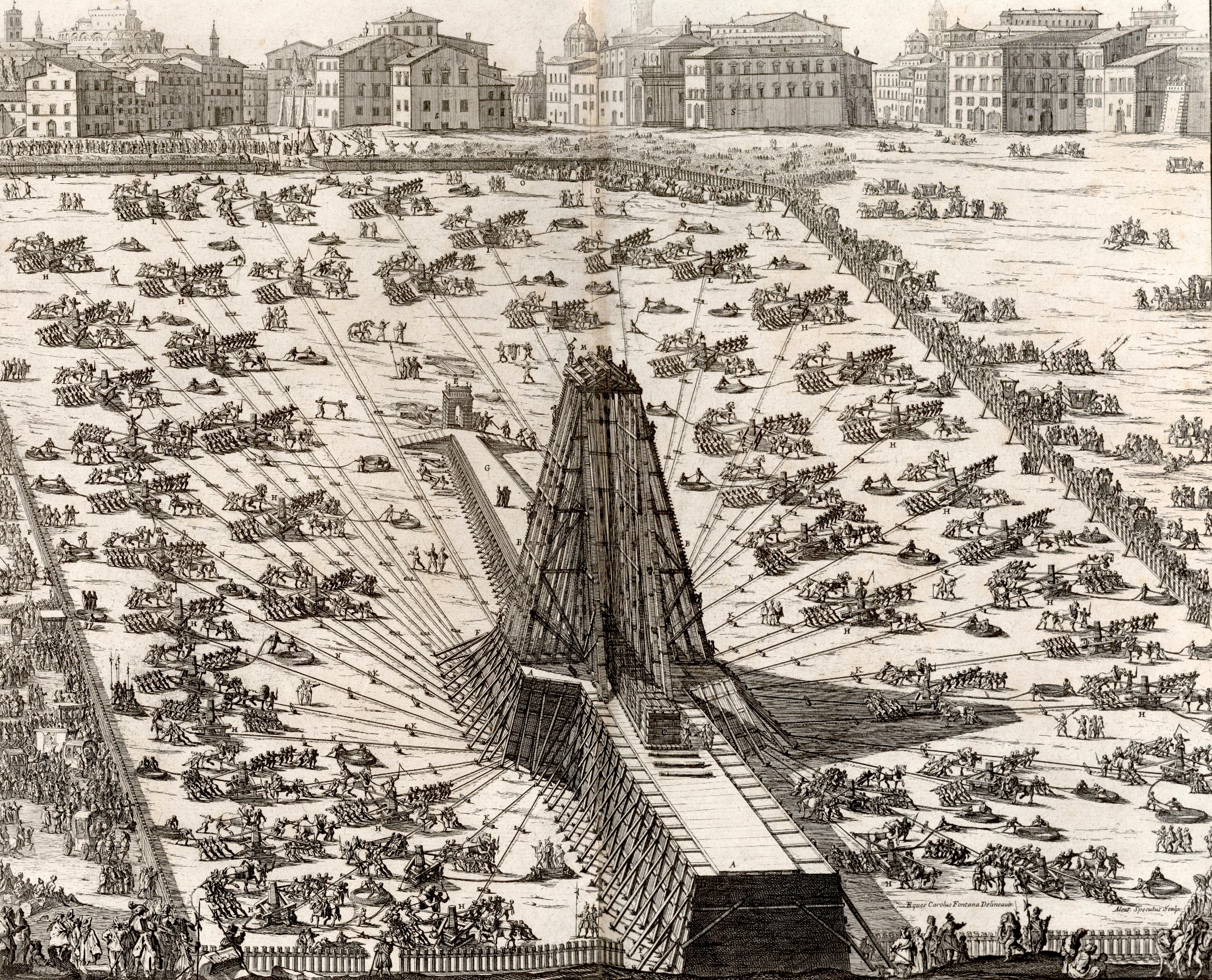
As St. Peter’s living witness, and as a relic of two great empires, the obelisk needed to be moved to a place of honor in front of the new Basilica’s soaring dome. It would stand triumphantly in the center of the new St. Peter’s Square, the Vatican’s beating heart. But the Church had to find someone willing to take responsibility for moving the fragile, 340-ton relic. Michelangelo turned down the job as too difficult.
To move it just a few hundred feet, two books and numerous proposals had to be published. The project, finally completed in 1586, required 900 workers, 140 horses and 56,000 pounds of rope and wood.
For the reigning pope, Sixtus V, it was a major accomplishment. It represented the Church’s power over all competing authority, present or past. The dedication ceremony climaxed with the crowning of the obelisk with a gold cross and an exorcism. The text of the exorcism was carved into the obelisk itself, along with Sixtus V’s name. Anyone present at the ceremony received a 15-year indulgence.
It was the height of Sixtus V’s career. He wanted an obelisk in front of every church in Rome.
So they started digging under dilapidated houses and trash heaps to find more.
By the late 18th century, about a dozen had been located in Rome. Some took generations to be re-erected, their missing parts replaced with fragments of other ancient monuments scattered across the city.
~*~
The late 18th century was a moment when a new-found admiration for ruins, a desire to categorize and catalogue the world, and military adventurism conspired to dramatically alter Europe’s relationship with the ancient monuments of the Middle East.
All of these impulses came together in Napoleon, the leader of a revolution both uncompromisingly rationalist and hopelessly melodramatic. It worshipped the past as it aimed to destroy it: Gothic churches and monasteries were demolished, while new national buildings inspired by antiquity were planned.
The revolutionaries saw themselves as modern-day followers of Socrates, the martyr for rational truth. On the other hand, Napoleon was inspired by the disciple of his disciple, Alexander the Great.
Napoleon sailed to Alexandria with the Revolutionary army in 1798. It was 2,129 years after Alexander laid out the street grid and 1,828 years since Augustus defeated Mark Antony there.
The expedition was one of the most romantic and ill-conceived campaigns of Napoleon’s career. He abandoned his army there just 14 months later. But it wasn’t all for nothing. A division of artists and scientists came along to document the ancient monuments, modern cities, and wildlife of Egypt.
A pair of obelisks at the entrance to Luxor Temple caught their eye. They had been standing there since they were carved under the reign of Ramses II in the 13th century BCE. They were measured, drawn, watercolored, and etched from every angle. Copies were printed for every antiquarian in Europe.
Immediately, “Egyptomania” transformed fashion, architecture, and interior design in the most up-to-date circles of Western cities. Mummy unwrapping parties became a fad among English aristocrats. Obelisks sprouted up in new, secularized European cemeteries. There were reverberations as far as small-town upstate New York, where Joseph Smith received his revelation of the Book of Mormon in “Reformed Egyptian” in 1828.
Forty years of coronations and revolutions followed Napoleon’s campaign in both Egypt and France, but the obelisks were not forgotten. After 16 years of active negotiation, unprecedented feats of engineering, and back-breaking labor, one of them was dragged across the Mediterranean and set up on Place de la Concorde in Paris in October 1836. It was the first stone monument to cross the Mediterranean in 1500 years.
The other obelisk still stands in Luxor, counting every day of the two centuries since it lost its companion of three millennia.
This event inaugurated a century of industrial-scale extraction and export of Middle Eastern monuments to Europe and North America.
The monuments still visible on the surface weren’t enough to fill the hunger. Like Sixtus V, 19th-century scientists and diplomats began digging to find more. Seven years after the Luxor obelisk arrived in Paris, the first major European archaeological excavation in the Middle East was begun by the French at Khorsabad, now in Iraq.
In the following decades, European and Euro-American soldiers and scientists touched every inch of the globe and sent back monuments in stone that joined the rivers of imported silver, cotton, and porcelain with the same destinations.
They built empires that lost themselves in the pull of the impressive and the novel, defining their power by trying to tame it in catalogues and categories. The most significant monuments of Western Imperialism are neither cathedrals nor palaces, but national museums, emporia of imported grandeur. I have spent many wonderful days wandering inside.
These vast collections of monuments still exert an unyielding power over our bodies — no visitor can examine even a fraction of the works that fill their endless halls without feeling their vision blur, their eyelids droop, and their knees buckle.
~*~
This is the first of three essays written in conjunction with the installation of SaraNoa’s stone, clay, and water works at the Institute for the Study of Ancient Cultures in Chicago’s Hyde Park. The works explore the removal, storage, and decay of monuments through the stories of Hyde Park’s stone monuments. The exhibition runs through March 14, 2027.
In two weeks: The Monuments Resist.
Previous: Armenian Gold.
Start from the Beginning: Watching a City Drown.
Text © 2026 Akiva Sanders. Drawings © 2026 SaraNoa Mark. Photos © 2026 Akiva Sanders and SaraNoa Mark, unless otherwise indicated. All rights reserved.
All ideas shared here were developed jointly in conversation.
Further reading
Brier, Cleopatra’s Needles: The Lost Obelisks of Egypt (Bloomsbury, 2021) – Tracking the obelisks from Egypt to Europe and the United States.
Dibner, Moving the Obelisks; A Chapter in Engineering History in which the Vatican obelisk in Rome in 1586 was Moved by Muscle Power, and a Study of More Recent Similar Moves (MIT Press, 1970) — found this book (by an engineer and pioneer in the history of technology) in the sleeve of a much less interesting book I bought at a flea market in college.
